By Delta Innovation Center
Innovative Gold Recovery from Refractory Sulfide Ores
Develop and validate an economical pretreatment and recovery route for gold locked in refractory sulfide minerals.
0 participants competing
Overview
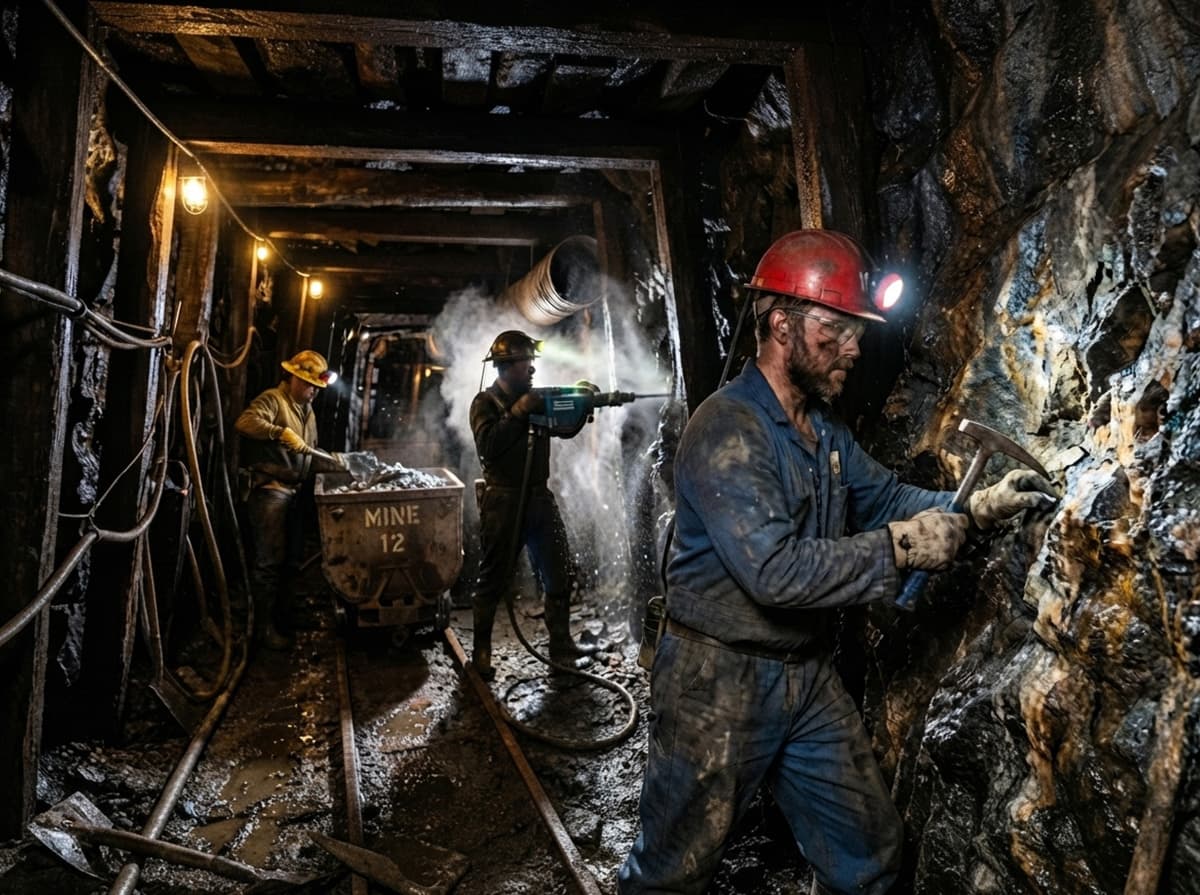
Gold recovery from refractory ores is substantially reduced because fine gold is locked within arsenopyrite and pyrite and is therefore inaccessible to direct cyanide leaching. Carbonaceous matter and minerals that consume cyanide or oxygen further reduce recovery, causing a significant share of the contained gold to report to tailings. The current process relies on conventional cyanidation without a proven pre-oxidation stage. Recovery from refractory feed is reported to remain below approximately 40 percent, while longer residence time and higher reagent consumption have not produced an economical improvement. The challenge is to establish a technically proven and economically viable pretreatment and recovery route that releases gold from the sulfide matrix, improves overall recovery, reduces unit cost, and enables responsible management of arsenic-bearing residues.
Ideal Participants
Eligible applicants include mining companies, research centers, and multidisciplinary teams with documented experience in mineral processing or extractive metallurgy, access to laboratory and pilot facilities, and the ability to complete metallurgical balances, HSE planning, waste-stability assessment, and techno-economic analysis.
Rules
By submitting a proposal, the applicant confirms that the proposed pretreatment and gold-recovery route will comply with the technical, HSE, environmental, documentation, pilot-validation, and stage-gate evaluation requirements stated for this challenge. Commercial terms, intellectual-property allocation, access to samples and facilities, and final acceptance criteria are valid only after approval in the final contract.
Payment Milestones
A 10,000,000,000 T payment pool will be released across milestones, unlocked after each stage is completed and approved.
Mobilization and approved technical plan
2,000,000,000 T
Generated non-binding planning phase based on the workbook maximum R&D budget.
Validated pilot milestone
4,000,000,000 T
Generated non-binding planning phase based on the workbook maximum R&D budget.
Final acceptance
4,000,000,000 T
Generated non-binding planning phase based on the workbook maximum R&D budget.
Resources & Datasets
Download technical specifications, sample datasets, and reference materials. Unlock by registering for the challenge.
Judges & Scoring
Review Scorecard, Submissions are evaluated across the following weighted criteria. Maximum total: 100 points.
Submission Requirements
- Unacceptable approaches: Methods based on mercury or prohibited reagents; roasting without arsenic gas and SO₂ control and fixation systems; direct cyanidation without pretreatment; and any solution that introduces arsenic into tailings in unstable and non-fixable form.
- Legal requirements: Compliance with the Mining Law and its implementing regulations, Mine Safety Regulations, Waste Management Law and special waste regulations regarding arsenic-bearing tailings, Environmental Protection Organization requirements for wastewater and gas emissions, and regulations for storage and use of controlled chemicals.
- Environmental requirements: Stable fixation of arsenic in residue and proof through leachability testing, prevention of groundwater contamination, control of arsenic gas and SO₂ emissions, and compliance of effluent with Environmental Protection Organization permissible limits.
- Minimum acceptable output: At least 70% gold recovery at pilot scale on reference feed, with proven repeatability in at least three operational campaigns and submission of documented pathway to achieve 85% target at industrial scale.
- Pilot requirement: Yes, pilot implementation is mandatory.
- Evaluation method: Complete metallurgical balance on employer reference feed: determination of head and tail grades in a certified laboratory (Fire Assay for gold), recovery calculation and test repetition in at least three stable pilot campaigns; along with measurement of specific reagent and energy consumption and evaluation of arsenic residue stability through leachability testing.
- Eligibility: Teams, companies and research centers with documented experience in the field of "Mineral Processing and Extractive Metallurgy", ability to design and implement a pilot, provide HSE program, technical-economic analysis, and deliver reproducible documentation.
- Technical constraint: Prohibition of mercury and unauthorized toxic reagents; limitation on arsenic gas and SO₂ emissions that rules out roasting without gas treatment systems; need for process compatibility with existing plant equipment and infrastructure; and necessity for domestic availability of reagents and spare parts.
Frequently Asked Questions
Have more questions? Our support team is always ready to help.
Location Tehran.Tehran
Presented by
Presented by Delta Innovation Center
Location Tehran.Tehran
Presented by
Presented by Delta Innovation Center